WHATIF Lee’s “if practicable” order was acted upon by LTG Ewell?
He’d have had MG Early’s division push down the east side of the city and swing around towards the Cemetery. Since the cemetery is the only point of Union activity, let’s assume that Early ignores Culp’s Hill and launches an attack on those Union troops. Again, for the sake of argument, let’s predicate that he catches MG Schurz’s division of Howard’s Eleventh Union Corp by surprise. Heavily engaged in fortifying the cemetery, they had their weapons stacked and unloaded. The rebel yell from their east quickly routs them. After a brief fight, Early has full control of the cemetery and a huge cache of cannons and muskets.
At the Gatekeeper’s house on the reverse slope of the cemetery, LTGs Hancock, Howard and Sickles flee south if only to avoid capture and set up their HQ at the Spangler farm on the Baltimore Pike.
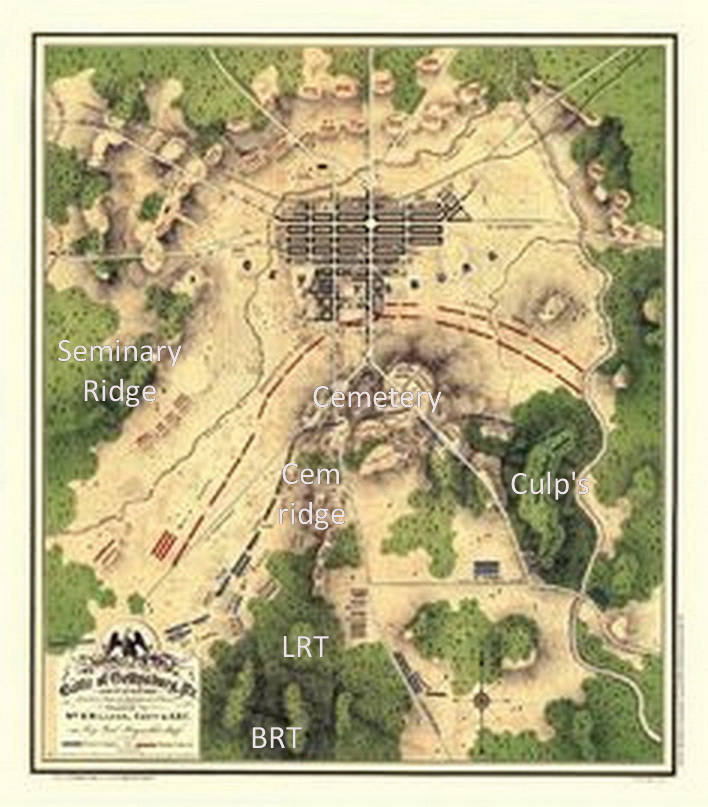
With Early in firm control of the cemetery heights, he only has to await the arrival of the now broken Union troops. The first to swing around the west edge of the city is the Iron Brigade. But being under full control of their officers and highly disciplined, they fail to blunder into Early’s sights. COL Meredith halts them where the edge of the city can offer some protection and so he can survey the situation. Other units begin to bottleneck behind him. He decides to use the Emmittsburg Road as an escape valve to get his men south to fight another day.
GEN Lee is watching all of this develop from the cupola of the Seminary. By deploying his two reserve brigades, MG Rodes was pressing the Union forces down the west side of town. Unfortunately, many of the others had taken off in pursuit of the men fleeing into the city. It is going to take some time to reestablish order.
It isn’t too long before the fleeing Union troops, some armed some not, begin to emerge in small disorganized groups from the south edge of town. This brings them into range of Early’s men. By delaying their fire for a few moments, those men are caught unaware and out in the open. Quickly, however, the exodus from the shelter of the town ceases.
Lee orders Pender’s division of Hill’s Corps to occupy the buildings of the Seminary overlooking the edge of the town and to spread south in parallel to the Emmittsburg Road. He tells them to harass those trying to flee south but to avoid a direct engagement. He is concerned that Early’s position is vulnerable but doesn’t feel that he can do anything to immediately relieve him. He seems stable for the night.
Back at the Union HQ, just as the sun was setting behind Seminary Ridge, the vanguard of LTG Slocum’s Twelfth Union Corps arrives via the Balto Pike. Hancock held them behind Power’s Hill so as not to tip off their arrival. He directed the first brigade to make their way as stealthfully as possible up onto Culp’s Hill. He positioned the available artillery on top of Power’s Hill.
Earlier Hancock had sent staff riders west to scout the Emmittsburg Road. There they found the first of the ‘escapees’ who were soon followed by Meredith’s Brigade. Since they were the first organized unit, Hancock positioned them astride the lower end of Cemetery Ridge. They were to act as trip-wire or blocking force against any Rebel troops that might venture that way. Stragglers were directed to continue south while any armed units were sent over to the Taneytown Road area. Slowly, he was assembling a force to deal with any Rebel attack.
At the Peach Orchard, Sickles awaited the arrival of his two divisions. He had dispatched staff officers to speed them along.
Hancock also knew that his own Second Corps would arrive via the Taneytown Road sometime during the night as well. By morning, he’d have a reasonable size force. The problem was that for the most part they’d be out in the open.
As night fell, much of the First and Eleventh Corps stragglers pulled back into town to cover themselves from harassing fire from the Rebels. Some continued to use the sunken road to slip south. The Rebels settled in for the night confident that they could mop up in the morning. They remained blissfully unaware of two more Union corps to their south.
Just before dawn, Hancock and Slocum made their way to the crest of Culp’s Hill. They needed to assess the lay of the land and disposition of troops. That vantage point would give them good view as far west as the Seminary grounds. To the NE, they could see indications of Rebel troop movements. MG Johnson’s division of Ewell’s Corps had bivouacked just east of the city with the expectation that they would move to reinforce Early at dawn.
Dawn DAY 2
Concerned about more Rebel troops in the area, Slocum had brought Geary’s Division around to the east slope of Culp’s Hill to protect that flank. They hadn’t had much sleep but they were on guard.
In the morning light, from Culp’s Hill the only troop concentration visible was in the cemetery. Pender’s men were more or less hidden in the Seminary buildings and the tree line to the south. Rodes was too far north along the city edge to be seen. Campfires to the east denoted more troops (Johnson).
No Union formations could be seen from Culp’s Hill so Hancock rightfully ascertained that they had pulled back into the protection of the city. But he had to assume that they were largely unarmed and disorganized. He and Slocum returned to the Spangler House to find GEN Meade having breakfast. They began to discuss their options.
The Union line ran west to east with Sickles’ Corp actually in the position that he would have occupied later in the actual Day 2. To his right, straddling the Taneytown Road was Second Corps. Between them were the scattered remnants of First Corps and on the far right was the Twelfth.
The Provost Guards had been rounding up the stragglers along the roads throughout the night. Most were Eleventh Corps, few were armed. Meade directed that they assemble at Taneytown to be rearmed with weapons brought from Westminster.
The fact that MG Early had been left on his own through the night, suggested that Lee intended to send him relief in the morning. Whatever Meade was to do, he needed to do it fast. Rather than an ‘all hands on deck’ attack, Meade decided on three divisions. Gibbons’ Division of Second Corps would launch the main attack along Cemetery Ridge into the Rebel rear. Geary’s Division would move around Culp’s Hill and support Gibbons from the east. Birney of Sickles’ Corps would move up the Emmittsburg Road at least as far as Zeigler’s Grove as the left flank. Other units would shift forward to support Gibbons as needed. Given Early’s isolated position, the generals agreed that three divisions should be enough to dislodge him.
Of course, Lee had not been idle. After dark, he had mobilized Anderson’s Division of Hill’s Corps and had them occupy the west face of Seminary Ridge. At dawn, they were to move over the crest and onto the east slope. With them on his right flank, Pender was to close the gap across the Emmittsburg Road, thereby cutting off the escape route. Finally, Johnson would occupy Culp’s Hill. Once all this was in place, Rodes and available remnants of Heth’s Corp would attempt to purge the city of the Union troops hiding there.
Neither Army had taken into account movements by the other!
From the crest of the ridge, Anderson’s infantry were surprised to see Birney’s men proceeding cautiously up the Emmittsburg Road, but they were too far up the ridge to effectively engage. They’d wait for a second chance as they moved down the slope hidden by the trees.
Gibbon’s attack was detected and encountered heavy Rebel fire as they approached from the south. His left flank was able to enter Zeigler’s Grove and use the trees for cover but Gibbons’ advance stalled. It fell to Geary moving from the east to try to retake the cemetery. He was having reasonable success until Johnson’s Division appeared to his rear. Meanwhile the cannons assembled on Power’s Hill were pouring fire over the crest into the north facing side of the cemetery.
Geary’s attack disassembled as most of his men turned left and escaped down the Balto Pike to avoid Johnson’s on rush. This cleared the way for Johnson to join up with Early forming a solid line over to the base of Culp’s Hill. The few Union troops above them were in no position to bring down fire or attack. There had not yet been an opportunity to manhandle any cannons up the steep wooded slope. Birney attempted to shift east to gain entry to the cemetery via Zeigler’s Grove, but he came under heavy fire from Pender and some of Anderson’s cannons as he pivoted. Humphrey’s artillery answered from the Peach Orchard area.
It wasn’t until Meredith’s Iron Brigade and some of the remnants of First Corps came up on Gibbon’s right flank that Early’s men began to falter. Some of Geary’s men rallied and joined in as well. As noon approached there was hard hand-to-hand fighting in and around the cemetery.
With Early’s occupation of the cemetery broken — at least for now, Union colors were boldly waved in the cemetery. This was a signal to any who could see that they could make the break from the protection of the city to rejoin the Union line. Johnson was close enough to the east that most but not all made it back!
Slocum’s was only a two division Corps, but BG Williams advanced his troops up the Balto Pike sweeping up Geary’s men and pressuring Johnson’s division. Geary’s men gleefully escorted Early’s captives southward.
Lee now faced a dilemma. Longstreet’s two divisions were assembling near Cashtown. Should he commit them? And where? ‘Ole Pete’ had set forth an argument an enveloping move to the south. But Lee was still concerned that he had no true idea of the exact strength or position of the Army of the Potomac. What if he sent Longstreet’s Corp south and it encountered a stronger force? He had no free troops to send to his rescue. It also greatly concerned him that he now had both Early and Johnson in relatively unsupported positions. He needed to ensure their safety before he committed Longstreet.
He was apprised of the Union success in extracting more men from the city and encouraged Rodes to redouble his efforts to capture those still in hiding before they attempted to escape.
Day 2 afternoon settled into a staring contest with neither side willing to risk a bold movement.
Dawn Day 3
Despite the many campfires burning in the valley, Anderson arose to find no Union troops in sight!
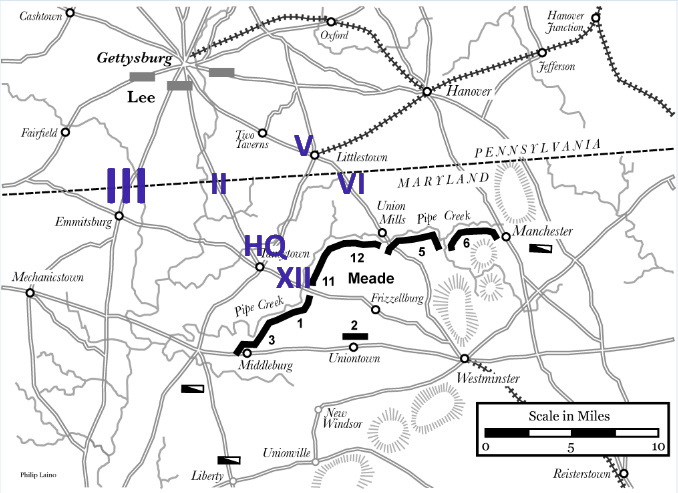
Meade had made his decision! With Sickles as a rear guard along the Emmittsburg Road, Meade had withdrawn his army south to Pipe Creek. If Lee wanted to pursue him, the clash would take place on a field of his choosing!